

The Entryway: Q2 2026 Market Update & Outlook
Market Snapshot:
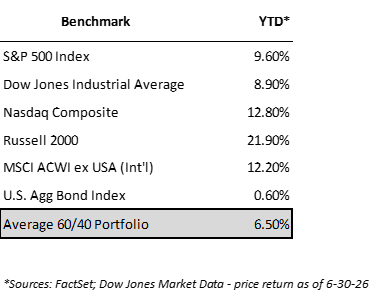
What a difference three months makes. When we wrote to you in early April, the S&P 500 had just fallen roughly 9.5% from its January record, the “Magnificent 7” were leading the market lower, oil was spiking from the war in Iran, and most investors were feeling anxious. However, from those late-March lows, U.S. stocks staged one of their strongest quarterly advances in recent memory. The S&P 500 and Nasdaq had their best quarters since the spring of 2020, with the S&P gaining ~15% and the Nasdaq climbing more than 21% in Q2. In fact, during the second quarter, all three major U.S. indices set record highs along the way with the S&P 500 and Nasdaq Composite hitting all-time highs on June 2nd, and the Dow Jones Industrial Average setting its own all-time high on June 30th, the final trading day of the quarter.
At the end of the second quarter, here is where the major indices stood YTD:
Below are a few themes we felt deserved more attention:
First, the rebound was real (dynamic earnings growth vs. hype).
S&P 500 companies grew earnings roughly 28% year-over-year in the first quarter, which was the fastest pace since 2021. For perspective, the average year-over-year earnings growth for the S&P 500 index from 2001 through 2025 was ~7.5% per year. The bottom line is Q1 earnings exceeded all market participants’ expectations and company valuations responded. As we move into Q2 earnings season, analyst’s expectations are another blockbuster quarter with analysts expecting year-over-year quarterly earnings growth of roughly 25% in Q2. In addition to earnings, companies are continuing to grow their top-line revenue with year-over-year revenue growth for S&P 500 companies standing at 10.9% vs. an average of ~5%/yr from 2001 through 2025. Bottom line, we are currently living through an exceptional period where companies are growing their sales and expanding their profit margins at the same time, which is what turns solid revenue growth into extraordinary earnings growth.
In our opinion, this earnings backdrop is the essential context for any discussion on valuations, which on the one hand look rich until you appreciate the earnings and earnings growth that sit beneath them. Currently, the S&P 500 trades at roughly 25x its trailing twelve-month earnings and about 20.5x forward earnings vs. a 30-year forward earnings average near 17.5x. This puts the index’s current price roughly 17% above its historical norm.
However, as we just discussed companies’ earnings are growing faster on average than at any point over the last 25 years. While stocks at large are trading higher than previous norms, they are also growing revenue and profits at a higher clip. In turn, investors are generally willing to pay a somewhat higher multiple. In our opinion, it has been the general earnings growth vs. speculation that has driven the market higher and also shifted investor sentiment to other parts of the market.
Second, market returns have continued to shift / broaden.
The rally began where most of the gains have occurred in this cycle, large-cap technology stocks and the AI “hyperscalers”. But by quarter’s end the gains had spread across much of the market. For instance, small cap companies came roaring back with the Russell 2000, surging nearly 22% and off to its’ best start to a year since 1991. In addition, major international indices continued to perform well YTD. In fact, since the start of 2025, the MSCI ACWI ex-US (Int’l benchmark) has handedly outperformed the S&P 500, which has been a welcomed bright spot for diversified investors.
In general, when more companies, areas of the economy, and parts of the world do better and attract more investment dollars it’s a healthy sign and makes the overall rally more durable / sustainable. In addition, we believe this is a useful reminder of why we diversify between company types (i.e., large, mid, small, growth vs. value, sectors, etc.) and globally rather than betting everything on one sector or country. We believe this gives investors the highest probability to capture the highest risk-adjusted returns, reduces their overall volatility, and lowers investor’s concentration risk.
Third, a word on concentration.
We have raised this concern for years, and it remains the single most important structural feature of most major US indices. For instance, the ten largest companies in the S&P 500 — Nvidia, Apple, Microsoft, Amazon, Alphabet, Broadcom, Meta, Tesla, Micron, and Berkshire Hathaway — now account for roughly 38% of the entire index’s market value, the highest in over 30 years. This means a small handful of companies are driving an outsized share of your returns, which can be concerning.
But here is the nuance most miss: those same ten companies have also been responsible for most of the earnings growth within this cycle. For instance, over the last 12 months, these same 10 companies are responsible for ~35% of the S&P 500 ‘s earnings. So, while we welcome the broadening of the market and will continue to constantly monitor this concentration risk, these are generational business, run by generational leaders, that have created real products and services that people love to use. In addition, they have historically run excellent businesses, with high margins, where they were able to capture those sales and turn them into significant profits. The main question today for most of these companies is where are those profits going now, is it sustainable, and will there be a commensurate near-term pay-off?
Hyperscalers and the data-center arms race.
To us, nothing embodies this concept more than hyperscalers. So, let’s zoom in on four of those giants: Amazon, Microsoft, Alphabet, and Meta. Through the first quarter of this year, these companies collectively generated ~$1.7 trillion in revenue and nearly $450 billion in net income!
Individually the figures are staggering as Amazon produced roughly $743 billion in revenue ($91 billion in profits), Alphabet about $422 billion ($160 billion in profits), Microsoft about $318 billion ($125 billion in profits), and Meta about $215 billion ($71 billion in profits). In short, these are not speculative start-ups — they are cash machines with dominant franchises in cloud computing, search, advertising, software, and retail.
However, what they are now doing with this cash is generating the most discussion as all four are aggressively spending money to build out the infrastructure that is powering artificial intelligence: AI models, data centers, custom chips, cloud infrastructure, electricity, etc. For example, these four companies have announced plans to spend a combined ~$710 billion on capital expenditures in 2026! This is up roughly 77% from last year and, by most accounts, the largest coordinated corporate buildout in human history.
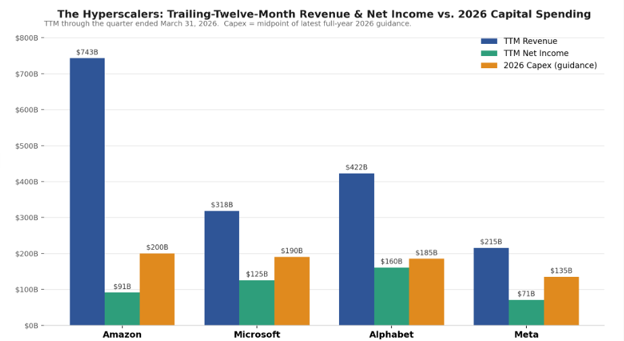
The magnitudes here are hard to overstate and this is a genuine arms race with each company telling investors they remain “capacity-constrained,” meaning they are unable to build fast enough to meet demand, with backlogs stretching into hundreds of billions of dollars. The wager is that whoever builds the most computing power will own the AI era. These companies and their strategies may prove brilliant, or it may prove excessive. The honest answer is that no one yet knows.
Macro Update: The War, the Fed, Jobs & the Consumer
The war in Iran and energy.
The defining event so far of this year remains the conflict that began on February 28th, when U.S. and Israeli forces struck Iran and Iran responded by closing the Strait of Hormuz — the narrow waterway through which roughly a fifth of the world’s oil flows. The result was the largest disruption in the history of the global oil market with crude spiking above $110 a barrel, gasoline at the pump climbing toward $4.50 a gallon in parts of the US and causing general uncertainty for the world.
The encouraging news is that the situation has meaningfully de-escalated since our last note with the United States and Iran signing a 60-day memorandum of understanding in mid-June to extend the ceasefire and negotiate a lasting agreement. Since then, the Strait of Hormuz has begun to open, oil prices have fallen sharply (down roughly 30% over the quarter and back near its pre-war level around), and prices at the pump are following it lower. The longer this drags on, the higher likelihood of renewed volatility, higher oil prices, higher inflation, etc. While we are not declaring victory, we are cautiously optimistic the worst is behind us.
The Federal Reserve.
This quarter brought a changing of the guard at the Fed as Kevin Warsh took over as Fed Chair in May. At his first meeting in June, he delivered a message that surprised many. While the Fed held its benchmark interest rate steady at 3.50%–3.75%, the member’s interest rate projections flipped, from expecting rate cuts this year to signaling a possible rate hike before year-end. As a reminder, coming into 2026, markets were pricing in two rate cuts this year; whereas, today, thanks to the inflation reignited by the recent oil shock, the debate has shifted to whether the Fed’s next move is up rather than down. That is a meaningful change, as interest rates impact everything from real estate & housing to consumer spending, to businesses, and capital markets.
Inflation.
In our opinion, the reason for the Fed’s hawkish turn is straightforward. After grinding lower for two years, inflation reaccelerated with consumer prices rising 4.2% year-over-year through May. This upward change was primarily driven by energy prices, and the Fed’s preferred gauge has now ticked higher three months in a row. As mentioned, the longer the uncertainty in the oil markets last, the more inflationary pressure (and potentially higher interest rates) we will see.
Jobs.
While the labor market is still objectively strong, it is beginning to cool. Employers added just 57,000 jobs in June, which was a sharp slowdown from earlier in the year, and prior months were revised lower. While the headline unemployment rate actually ticked down to 4.2% in June, it did so for the wrong reason as more people simply stopped looking for work, pulling labor-force participation rate down to 61.5%, its lowest level since 2021. So, while the job market is softening at the edges the unemployment rate is still low by historical standards and wages are continuing to grow (albeit not as fast as inflation for some).
The two economies.
Beneath these headlines, the “K-shaped economy” we have written about for years is becoming more pronounced. Bottom line, households that own assets: homes, stocks, businesses, etc. have watched their balance sheets grow and can better absorb higher prices. However, households that don’t are increasingly financing daily life with debt, and the strain is starting to show. For instance, total household debt hit a record $18.8 trillion recently and auto-loan delinquencies are now the highest the New York Fed has ever recorded. In addition, credit-card delinquencies have climbed, and it’s been reported that more than half of consumers report carrying a credit-card balance just to cover essentials. The bottom line is the economy is relatively healthy, but the gaps between parts of the population is widening with the more affluent parts of the population really driving most of the sustainable spending while others are fighting to keep pace.
Closing.
We could fill ten pages talking about markets, debating the war, Fed policy, AI, and where the market potentially heads from here. All these things are interesting, and they do matter. But if you focus all your energy there you really miss the point and will create much unneeded stress and anxiety. The bottom line is these things are out of your control, and they are not the biggest factors in determining your success and peace of mind. Our job is to shoulder most of that burden for you, cut through the noise, and put you in a position for success. The most helpful / valuable things we can do is have honest, transparent conversations, build out a custom plan around your needs, stay disciplined to that plan, and continue to communicate as life and the world changes around us.
Thank you!
In closing, we are grateful for the opportunity to serve you and your families, and we do not take it for granted. We work incredibly hard to attract and retain people who bring an entrepreneurial spirit, a relentless drive, and a servant’s heart to their work, because our people and our culture are the foundation of everything we do for you. We love our team and we are excited to introduce to the Red Door Family, our newest team member in the family office operations, Hannah Knight.

Exciting Announcement!
Red Door is excited to announce that Josh Baker and Russell Hayes have officially joined Evans Petree PC as shareholders — bringing with them the same proactive, comprehensive legal counsel Red Door families know and trust. Evans Petree is a full-service law firm with over 120 years of history and offices in Memphis, Franklin, and Oxford, Mississippi.
We believe this move is a perfect fit — one that gives Josh and Russell the infrastructure and reach to keep doing what they do best, while expanding their ability to serve even more Red Door families over time. For existing clients, nothing changes. Same advisors, same approach, same commitment.
We couldn’t be more excited for Josh and Russell and we believe this is the right firm at the right time. We look forward to their continued representation of every Red Door family they serve and are excited about the future.
Josh and Russell’s updated contact information is below, along with a recent press release from Evans Petree officially welcoming them to the firm.
Evans Petree Welcomes Two New Shareholders to Estate Planning Practice Group
Josh Baker
901-474-6178
jbaker@evanspetree.com
Russell Hayes
901-474-6177
rhayes@evanspetree.com
As always, if you have any questions, please do not hesitate to reach out. We appreciate your trust and value our partnership.